Organigraphs: Seeing the organization for what it is
For further detail, see “Organigraphs: Drawing How Companies Really Work“ (with Ludo Van der Heyden), Harvard Business Review, September-October 1999 and “Re-viewing the Organization” (with Ludo Van der Heyden), Ivey Business Journal, September/October, 2000.
Some years ago, frustrated by being handed the organization chart when I asked for a picture of some organization I wished to understand—like being handed the family tree when you have asked to see the family album—I started to draw what I called organigraphs. (Organigramme is the French word for the chart.) I would sit down with a few people knowledgeable about the place and we would sketch on a whiteboard what really went on, how things flowed through the place, from beginning to end. (The vocabulary of chains, hubs, webs, and sets, discussed in Myth 2 of the book, was particularly helpful in doing these.)
Picture the various activities of an organization at work, producing its products and rendering its services, from a barbershop to a space agency. An organigraph is an effort to capture this, like a map. A map, in one image, shows the consequential places in a territory and the roads that connect them. An organigraph shows the consequential activities in an organization and the flows that connect them. It enables people to see the place holistically, including employees who can see their own place in it, beyond who bosses them on some chart. Here are some examples.
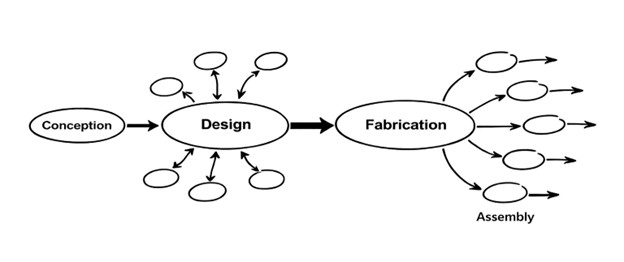
Aircraft production as a chain of hubs
Once a new airplane is conceived, design teams are formed for each component—wings, wiring, engines, etc.—as well as a team for the overall coordination of these teams. Each is a hub, for its component, but internally, each works as a web. Once the design is established, fabrication of each of these components begins, separately–in other words, as a set. Next comes assembly. There are planes whose components are put together on an assembly line, as in a chain, as is done for automobiles. But because airplanes are so much larger, they can instead stay in one place, to which are brought their various components—in other word, they can be assembled as a hub, as shown in the diagram. Finally, each airplane, one of a set, is flown off to its customer.
Organigraph of aircraft development
as a chain of hubs, some as webs within
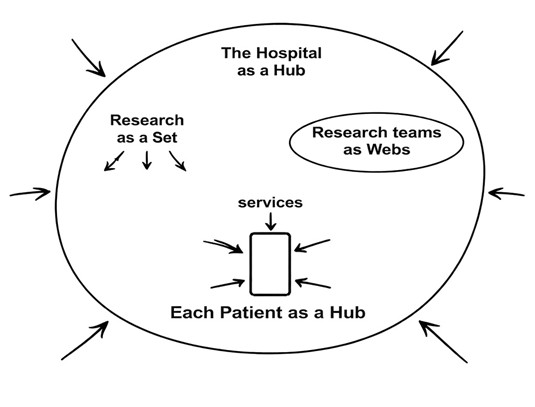
The hospital as a hub, where sets serve the patients as hubs
The hospital itself has been described in the Myth book as a hub, to which all kinds of people and services come, likewise is each of its patients, who stay in their rooms where they receive most of their services, professional and otherwise, as a set (nursing food, medical staff as well, who mostly treat their patients independently, but do sometimes form teams, to do research in webs).
Organigraph of a hospital, as a hub of hubs
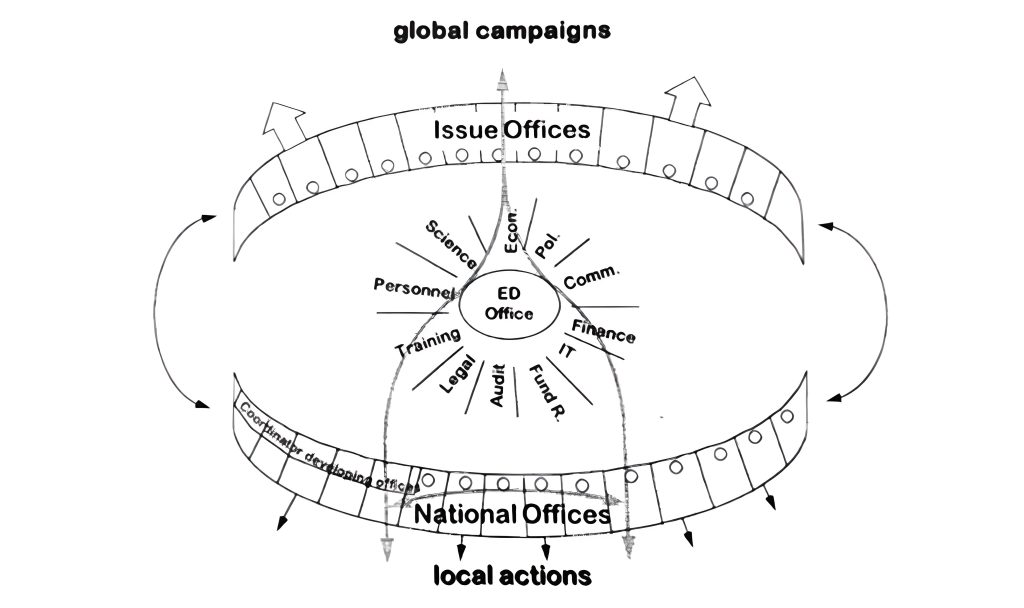
Greenpeace as a set of webs, local and global
Some years ago, working with people at the headquarters of Greenpeace in Amsterdam, I drew this organigraph, representing how it seemed to function at that time. At the top, the organization is shown as running global campaigns, for example, about climate change at conferences, while at the bottom, local actions are shown carried out by the national offices, for example, protesting the polluting of a river. Each campaign and action, global and local, tends to be rather customized, to deal with the issue at hand. It functions internally as a web, whose people interact every which way, and together, they form a set of activities, albeit with the local actions feeding into the global campaigns and the global campaigns stimulating local actions. In the middle is the executive office, as a kind of hub of advisory services and administrative supports.
Organigraph of Greenpeace, as a set of webs